


- 4 years ago
Chimphing
Chimphing is a local term to describe the seeds of Nepali Hogweed (cow parsnip). Scientifically, it belongs to the parsley (Apiaceae) family and Heracleum genus. Though, Heracleum L. contains more than 120 species globally, only ten of its species (H. brunonis, H. candicans, H. canescens, H. lallii, H. nepalense, H. obtusifolium, H. sphondylium, H. sublineare, H. wallichii & H. woodii) have been documented in Nepal (based on www.efloras.org & www.floraofnepal.org) so far. Most of the research conducted on Heracleum species has established these species as edible, especially as medicinal plants and to a lesser extent as food (herbs or spices). The vernacular name for H. Nepalese has been documented as चिम्फिङ्ग/ बुढो औषधी/भोटे जिरा. These plants are found growing wild at the altitude ranging from 1800 to 4600 m above sea level depending upon the species.
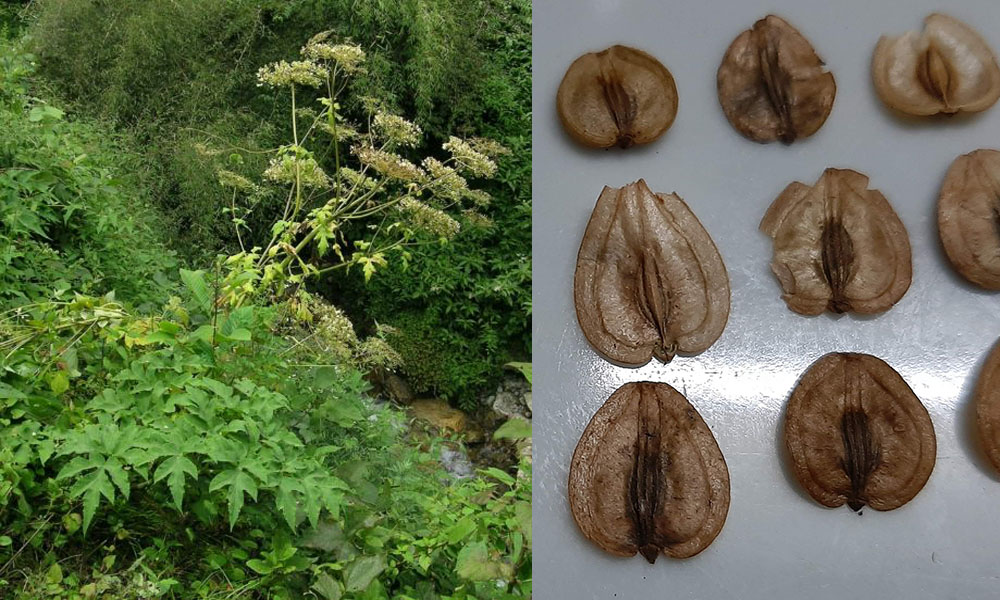
Nepali Hogweed plant & flower | Dried Chimphing seeds (L: H. dissectifolium (?) & R: H. nepalense)
Dried Chimphing seeds are obovoid, dorsally compressed, and laterally winged. The seeds are slightly bitter to taste, have a citrusy aroma, and leaves a tingling sensation on the tongue.
Proximate composition of dried Chimphing (wet basis).
| Parameters | % |
| Moisture | 9.87 |
| Crude fat | 6.52 |
| Crude protein | 21.64 |
| Crude fiber | 30.65 |
| Total ash | 0.07 |
| Carbohydrate | 31.25 |
| Energy (Kcal/100 g) | 270.24 |
Source: Nutritional importance of food found in forests (Ilam region), 2075; National Nutrition Program.
The seeds have been used as spices from time immemorial by several ethnic and indigenous people living in the high hills and mountains of eastern and central Nepal. Apart from the seeds, other parts of the plant have also been reported to contain different phytochemicals, which are the reason behind its broad use in traditional medicine against cough, nausea, vomiting, diarrhea, flatulence, inflammation, fungal infections, influenza, and convulsions.
In Nepal, Chimphing usage as a spice is mostly localized among the Indigenous Limbu community. They use Chimphing to spice up most of their dishes (pickles, chutney, sauces, meat curries, daal, stews, etc.). Roasting Chimphing either dry or in oil is a very common way of usage as heat releases the aroma. The combination of Chimphing goes very well with pork, black gram, niger seeds, and stinging nettle.
In addition to food, Chimphing seeds have been used by other ethnic communities and traditional healers as a remedy for different ailments, such as body aches, sinusitis, influenza, and stomach ache. These curative aspects of Chimphing must have been attributed by the different bioactive components found in the different parts of the plant. Different types of coumarins and furanocoumarins are considered as the major metabolites found in Chimphing, responsible for exerting several biological activities such as anti-neurodegenerative, anti-oxidant, anti-cancer, anti-microbial, anti-diabetic, anti-viral and anti-inflammatory effects. The tannins have been credited for anti-diarrheal activity; bergapten, heraclenin and sphondin for anti-inflammatory activity; octyl acetate, octyl isobutyrate, and terpenes (a-pinene, b-pinene, limonene) for anti-viral activities (against Influenza virus Types A: A/Betezda/63/10/H2N2 & B: B/Lee/40); psoralen for anticancer as well as antioxidant activities by several researchers.
Ethnobotnical uses of some Heracleum species found in Nepal:
| Heracleum species | Ethnobotanical uses | References |
| H. candicans | Spices, flavoring, aphrodisiac, tonic, colic, digestive, antipyretic, diaphoretic, itching, skin disorders, menstrual disorders | Rastogi et al., 2007; Tkachenko, 2010; Inoeu et al., 2011; Rawat et al., 2013; Chauhan et al., 2014 |
| H. nepalense | Breath rate stimulator, blood pressure stimulator, antidiarrheal, tonic, aphrodisiac | Dash et al., 2007; Bose et al., 2011, Shakhmatov et al., 2014 |
| H. sphondylium | Food, antihypertensive, diarrhea, dysentery, sedative, healing wounds, stomachache, digestive, aphrodisiac, menstrual problems, dyspepsia | Ozek et al., 2002; Ergene et al., 2006; Senejoux et al., 2013; Maggi et al., 2014; Shahmatov et al., 2014 |
| H. wallichii | Antidiarrheal, tonic, aphrodisiac, influenza, sinusitis, fever, body ache | Bose et al., 2005; Chettri, D.R., 2004; Ghimeray et al., 2010; Bantawa & Rai, 2009; Lepcha et al., 2019 |
Heracleum species is considered a potential source of medicinal compounds, it is not devoid of adverse effects. The same compounds, furanocoumarins, are capable of exerting either health-beneficial effects (anti-oxidants, anti-inflammatory) or unfavorable effects (phototoxicity, inflammation) according to the target organs. Some Heracleum species have been reported to cause hormonal changes during pregnancy. Coumarins, the major metabolites are capable of exerting toxicity to kidneys and livers when consumed in excess (Tolerable daily intake < 0.1 mg coumarin/kg body weight).
Apart from Nepal, seeds of other hogweed species are also eaten in India, Turkey, Afghanistan, Thailand, China, Azerbaijan, Iran, Canada, and The U.K. In Iran, it is known as Golpar seeds and is used in Persian cooking. These days, foragers and wild food enthusiasts from around the world are promoting as well as re-introducing the use of hogweed seeds in different processed food products for their exotic flavor.
The name hogweed itself is enough to indicate that the plant is considered a weed and a nuisance by those who do not recognize it. If locals are to familiarize themselves with this plant and its importance, harvesting and selling Chimphing could lead to income generation. Furthermore, because of the valuable phytochemicals that can be extracted from Chimphing, its pharmacological scope can be expanded beyond traditional applications.
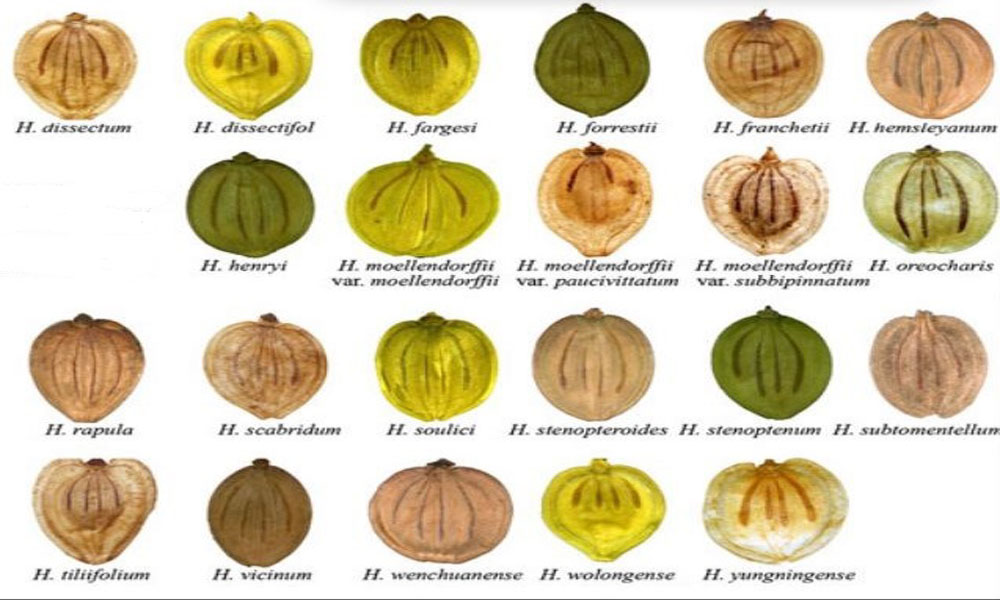
Seeds of different species of Heracleum.
Source: Yu, Y. et al., (2011). Phylogeny and biogeography of Chinese Heracleum (Apiaceae tribe Tordylieae) with comments on their fruit morphology. Plant Syst Evol 296, 179-203
References:
Bahadori, M.B., Dinparast, L., & Zengin, G. (2016). The genus Heracleum: A comprehensive review on its phytochemistry, pharmacology, and ethnobotanical values as a useful herb. Comprehensive Reviews in Food Science and Food Safety, 15, 1018-1039.
Bantawa, R., & Rai, R. (2009). Studies on ethnomedicinal plants used by traditional practitioners, Jhankri, Bijuwa & Phedangma in Darjeeling Himalaya. Natural Product Radiance, 8 (5), 537-541.
Bose, S. K., Dewanjee, S., & Mandal, S. C. (2007). Antibacterial activity of methanol extract of roots of Heracleum Nepalese D. Don. on bacteria causing diarrhea. Oriental Pharmacy and Experimental Medicine, 7 (3), 286-289.
Chettri, D. R. (2004). Medicinal plants used as antipyretic agents by the traditional healers of the Darjeeling Himalayas. Indian Journal of Traditional Knowledge, 3 (3), 271-275.
Dash, S., Nath, L.K., Bhise, S., & Bhuyan, N. (2005). Antioxidant and antimicrobial activities of Heracleum Nepalese D Don root. Tropical Journal of Pharmaceutical Research, 4(1), 341-347.
Devari, M., & Ezazi, R. (2017). Chemical composition & antifungal activity of the essential oil of Shumeria majdai, H. persicum & Eucalyptus sp. against some important phytopathogenic fungi. Journal de Mycologie Médicale, MYCMED 707, 1-6.
Ghimeray, A. K. et al. (2010). Wild edible plants of the Illam Hills (Eastern Nepal) & their mode of use by the local community. Korean J.PI. Taxon, 40 (1), 74-77.
Haghighi, M. & Mozafariyan, M. (2011). The introduction of extinct endemic vegetables of Iran. Journal of Medicinal Plants Research, 5(33), 7085-7107.
Lepcha, T. T. et al. (2019). Ethnomedicinal use of plants by Bhutia Tribe in Sikkim Himalaya. Proceedings of 1st Himalayan Research Consortium, 1, 71-78.
Singh, H.B., Prasad, P., & Rai, L.K. (2002). Folk medicinal plants in the Sikkim Himalayas of India. Asian Folklore Studies, 61, 295-310.
Tkachenko K. 2007. Antiviral activity of the essential oils of some Heracleum L. species. Journal of Herbs, Spices & Medicinal Plants, 12, 1–12.
RTRK: This Blog is used for basic knowledge about the Nepalese authentic Limbu community, who is working Food Production industry. This Blog belongs to https://mukum3.wordpress.com/